Book Review: ‘Democracy and its Critics – Robert A Dahl

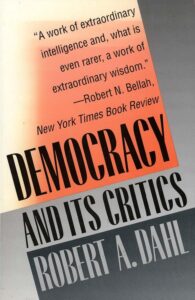
Robert A. Dahl’s Democracy and Its Critics (1989) is one of the most important works in modern political theory, examining the strengths and weaknesses of democracy. In this book, Dahl seeks to answer a fundamental question: Is democracy really the best form of government, despite its many criticisms? To answer this, he examines the arguments made by different thinkers who support and oppose democracy. By doing this, Dahl not only defends democracy but also explains its limitations and how it can work better in modern societies.
One of the key ideas in the book is that democracy should not be understood solely as an ideal system in which everyone directly participates in decision-making. In reality, modern societies are large and complex; therefore, the direct participation of all citizens in every decision is not possible. Because of this, Dahl introduces the concept of “polyarchy.” Polyarchy is a practical form of democracy that exists in most modern nations. In such systems, citizens participate mainly through representatives elected by popular vote. According to Dahl, polyarchy includes features such as free and fair elections, freedom of expression, access to diverse sources of information, and the ability of people to organise and form political groups.
Another important idea discussed in the book is political equality. Dahl argues that democracy is grounded in the principle that all citizens should be treated as politically equal. This means that every person should have an equal opportunity to express their views and influence political decisions. In democratic systems, this is usually achieved through voting, political participation, and open public debate. Dahl believes that democracy is morally justified because it respects equality among citizens.
However, Dahl also recognises that democracy has long faced criticism. One of the earliest criticisms comes from classical philosophers such as Plato, who believed that democracy could lead to poor decision-making because ordinary people may lack the knowledge or expertise to govern. According to this argument, decisions in a democracy may be based more on emotion or popular opinion than on rational thought. Critics worry that this could lead to instability and ineffective governance.
Dahl responds to this criticism by explaining that although citizens may not always have perfect knowledge, no other political system has proved better at protecting people’s rights and interests than democracy. In authoritarian or elite-controlled systems, decisions may be made by a small group that may not represent the interests of the majority. Democracy, despite its flaws, allows citizens to participate and hold leaders accountable.
The book also examines Marxist criticisms of democracy. Marxist thinkers argue that democracy in capitalist societies is not truly equal, because economic inequality leads to political inequality. In other words, wealthy individuals and corporations often have more political influence than ordinary citizens. They can fund political campaigns, influence the media, and lobby governments to advance their interests. This means that, even though everyone has the right to vote, some groups still have more political power than others.
Dahl agrees that economic inequality can pose problems for democracies. When wealth is concentrated in the hands of a few, those individuals may gain greater influence over political decisions. However, he argues that democracy still provides citizens with tools to challenge such inequalities. Through elections, political parties, public debate, and civil society organisations, people can push for reforms and hold governments to account.
Another issue Dahl discusses is the role of elites in democratic systems. In large societies, it is unrealistic for every citizen to participate in every policy decision-making process. Consequently, many decisions are made by political leaders, bureaucrats, and experts. Some critics argue that this means democracies are actually controlled by elites rather than ordinary citizens. Dahl accepts that elites play an important role in modern governance but emphasises that democratic systems include mechanisms to keep them accountable. Regular elections, competition among political parties, and freedom of speech help ensure that leaders remain responsive to public opinion.
The book also highlights some of the challenges that democracy faces in the contemporary world. One of the biggest concerns is growing economic inequality, which can undermine political equality. If some individuals or groups have far more resources than others, they may dominate political discussions and decision-making. This can erode trust in democratic institutions and leave citizens feeling that their voices do not matter in the political process.
Despite these challenges, Dahl remains optimistic about the future of democracy. He believes that democracy has a unique ability to adapt and correct its mistakes. Because democratic societies allow open discussion and criticism, they can identify problems and work towards solutions. For example, citizens can demand policy changes, support new political movements, or replace leaders through elections.
One of the strengths of Democracy and Its Critics is that Dahl does not blindly praise democracy. Instead, he carefully examines its weaknesses while explaining why it remains the most acceptable form of government. His discussion of criticisms, from classical philosophers to modern political theories, makes the book intellectually rich and thought-provoking. At the same time, his concept of polyarchy helps readers understand how democracy actually functions in real-world political systems.
However, the book has some limitations. Some scholars argue that Dahl does not fully address the extent to which economic power shapes politics. While he acknowledges the problem, critics contend that in many societies economic inequality is so pronounced that it significantly weakens democratic participation. Additionally, the book mainly focuses on democracy within individual countries and does not fully explore how democratic principles apply to global institutions and international decision-making.
Overall, Democracy and Its Critics remains an important contribution to the study of democracy. It helps readers understand both the strengths and weaknesses of democratic systems. Dahl shows that democracy is imperfect, yet it remains the most legitimate and flexible system of government available. By enabling citizens to participate in politics and hold leaders accountable, democracies create opportunities for continuous improvement and reform.
In conclusion, Robert A. Dahl’s Democracy and Its Critics offers a thoughtful, balanced analysis of democracy and the arguments against it. The book encourages readers to think critically about democratic institutions and the challenges they face in the contemporary world. Although democracy has many flaws, Dahl convincingly argues that it remains the best available system for securing political equality, protecting citizens’ rights, and enabling societies to evolve over time. For students of political science and anyone interested in governance, this book offers valuable insights into how democracy works and why it continues to matter today.
The book ‘Democracy and Its Critics’, authored by Robert A. Dahl, was first published in 1989 by Yale University Press.
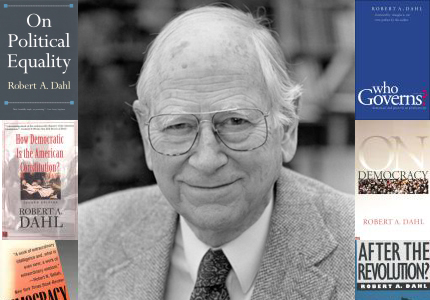
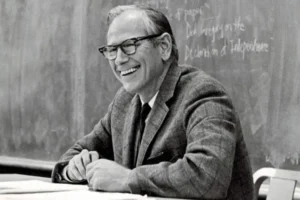
Robert A. Dahl was an American political theorist and Sterling Professor of Political Science at Yale University. He established the pluralist theory of democracy—in which political outcomes are enacted through competitive, if unequal, interest groups—and introduced “polyarchy” as a descriptor of actual democratic governance.